|
|
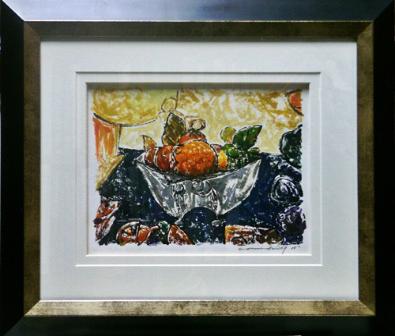
ORIGINAL MONO TYPE BY CONNIE HWANG
|
|
|
|
SOLD OUT
|
|
|
|
MONO-TYPE
( MEDIUMS AND METHODS FOR PAINTERLY PRINTMAKING )
Mono-typing is a type of printmaking made by drawing or painting on a smooth, non-absorbent surface. The surface, or matrix, was historically a copper
etching plate, but in contemporary work it can very from zinc or glass to acrylic glass. The image is then transferred onto a sheet of paper by pressing the
two together, usually using a printing-press. Mono-types can also be created by inking an entire surface and then, using brushes or rags, removing ink to
create a subtractive image, e.g. creating lights from a field of opaque colour. The inks used may be oil based or water based. With oil based inks, the
paper may be dry, in which case the image has more contrast, or the paper may be damp, in which case the image has a 10 percent greater range of tones.
Mono-typing produces a unique print, or mono-type; most of the ink is removed during the initial pressing. Although subsequent re-printings are
sometimes possible, they differ greatly from the first print and are generally considered inferior. These prints from the original plate are called " goast
prints " A print made by pressing a new print onto another surface, effectively making the print into a plate, is called a " cognate ". Stencils, watercolor,
solvents, brushes and other tools are often used to embellish a mono-type print. Mono-type can be spontaneously executed and with no previous sketch.
|
|
|
|
|